Europe has been here before. When Russia cut gas supplies in 2022, energy bills doubled, factories idled, and inflation reached levels not seen since the 1970s. Policymakers promised it would never happen again. They built new LNG terminals, signed long-term contracts with Norway and the United States, and diversified their supplier base. What they could not engineer away was the underlying architecture of Europe’s electricity markets, which still prices power according to the most expensive generator running at any given moment. In most of Europe, most of the time, that generator burns gas.
That structural weakness is now being tested by two forces arriving simultaneously. A widening war in the Middle East has disrupted LNG flows through the Strait of Hormuz, pushing the TTF gas benchmark from around 25 euros per megawatt-hour late last year to above 65 at its recent peak. And across the continent, the construction of artificial intelligence data centres is adding enormous new loads to electricity grids that were not built to carry them. Neither shock alone would be catastrophic. The trouble is that both are feeding through exactly the same mechanism at exactly the same time.
The gas price comes first
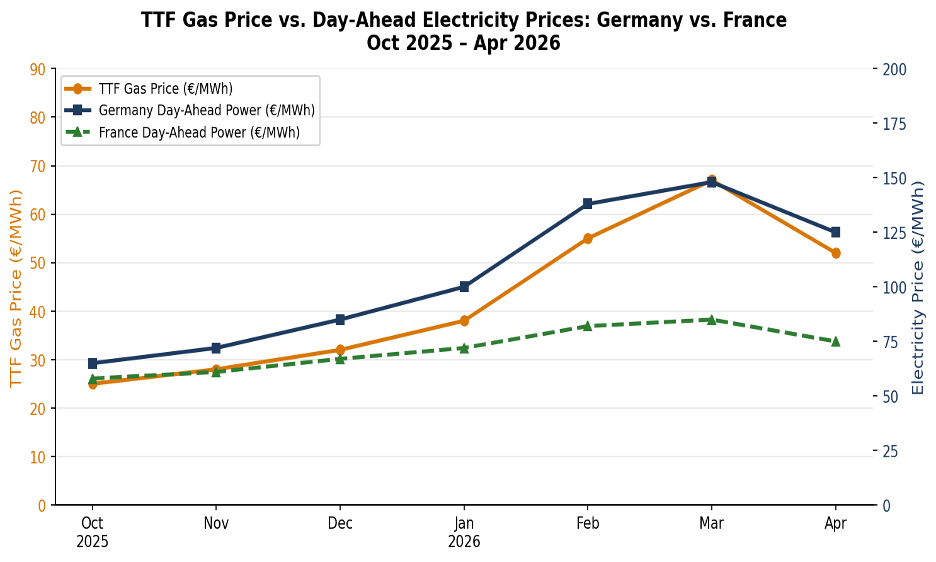
Chart 1: TTF gas benchmark vs. day-ahead electricity prices, Germany and France (Oct 2025–Apr 2026). Sources: IEEFA, European Gas Hub, ECB Economic Bulletin.
Because gas sets the marginal price of electricity across most of Europe, a TTF spike translates almost immediately into higher power bills. In Germany and Italy, day-ahead electricity prices climbed above 130 euros per megawatt-hour during the worst weeks of the Hormuz disruption. In France, which has more nuclear power, and in Spain, which has more renewables, prices stayed closer to 70. That gap matters enormously: it means the inflationary pressure is concentrated in precisely the two countries that account for the largest share of European manufacturing output.
The timing could hardly be worse. European gas storage heading into spring 2026 is badly depleted. Germany and France both have storage below a quarter full; the Netherlands is in an even more precarious position. Low storage means there is less of a buffer between any further disruption and another price spike.
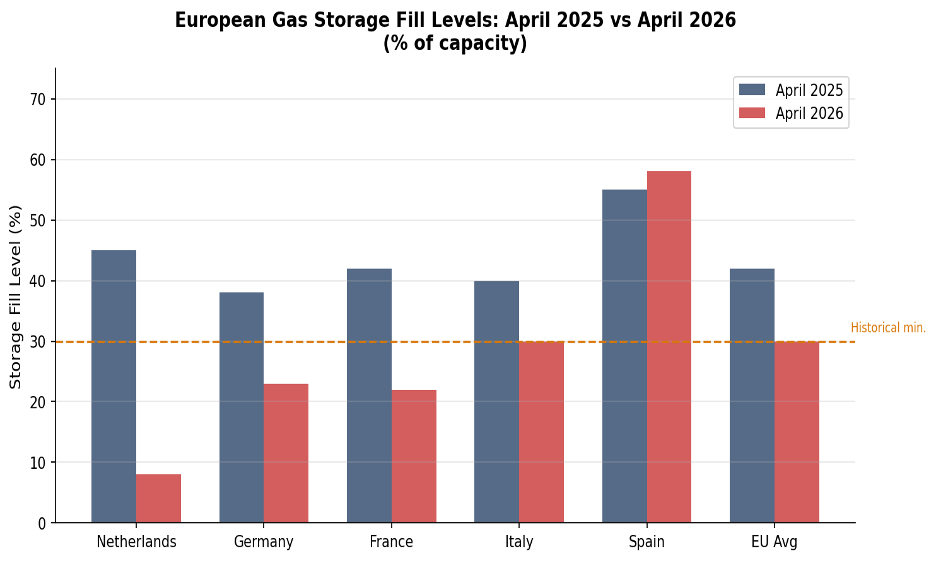
Chart 2: European gas storage fill levels, April 2025 vs April 2026 (% of capacity). Sources: IndexBox, European Gas Hub, ABN AMRO Energy Outlook.
Europe’s recent decisions have also narrowed its options. The EU agreed last December to ban Russian gas imports by the end of 2027, removing a supply source that, however politically toxic, had been dampening prices. The replacement, American LNG, has its own complications: US export policy is subject to domestic political pressures, and heavy reliance on a single supplier is not obviously an improvement over what came before. The ECB’s March 2026 projections now show headline inflation rising to 3.1% in the second quarter of this year. The IMF thinks it could reach 5% if the conflict drags on.
The second engine: AI and the appetite for power
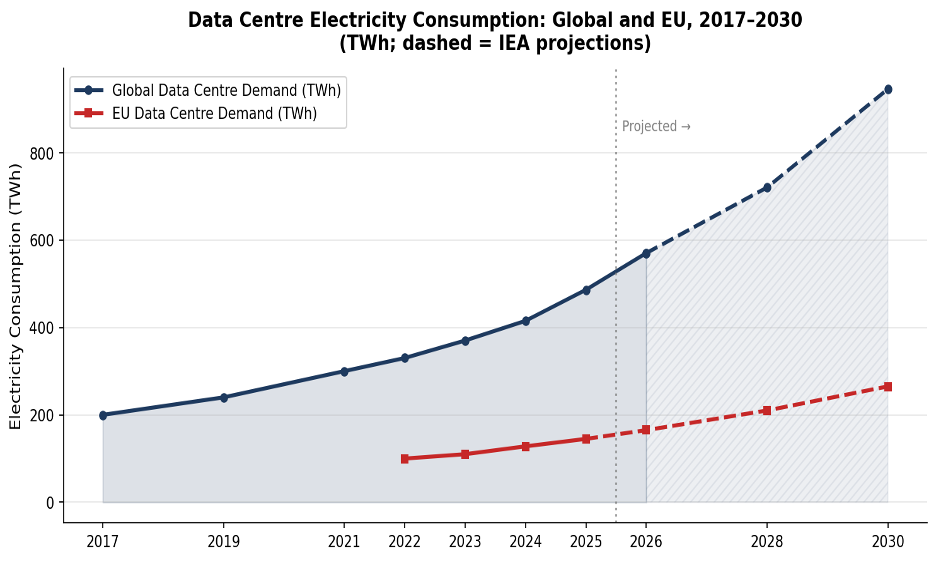
Chart 3: Data centre electricity consumption, global and EU, 2017-2030 (TWh; dashed = IEA projections). Sources: IEA Energy and AI 2025, IEA Key Questions on Energy and AI 2026, Ember.
The geopolitical shock would eventually subside if a ceasefire were reached. The second force driving European electricity demand is not going anywhere. Artificial intelligence data centres are being built across Europe at a pace that grids were not designed to accommodate. Global data centre electricity consumption grew 17% in 2025 alone and is on track to double by 2030, according to the International Energy Agency. The EU has set a target of tripling its own data centre capacity within seven years.
The reason cooling deserves particular attention is that it is not incidental to how data centres work: it is central. High-density AI server racks run near maximum thermal capacity continuously. Cooling those racks accounts for a substantial share of total electricity consumed, and as operators have moved away from water-heavy approaches under environmental pressure, the electrical load from cooling has grown. Ireland’s data centres already consume around 22% of the country’s electricity, a figure the IEA expects to reach 32% by next year. Frankfurt’s cluster accounts for roughly 42% of local demand.
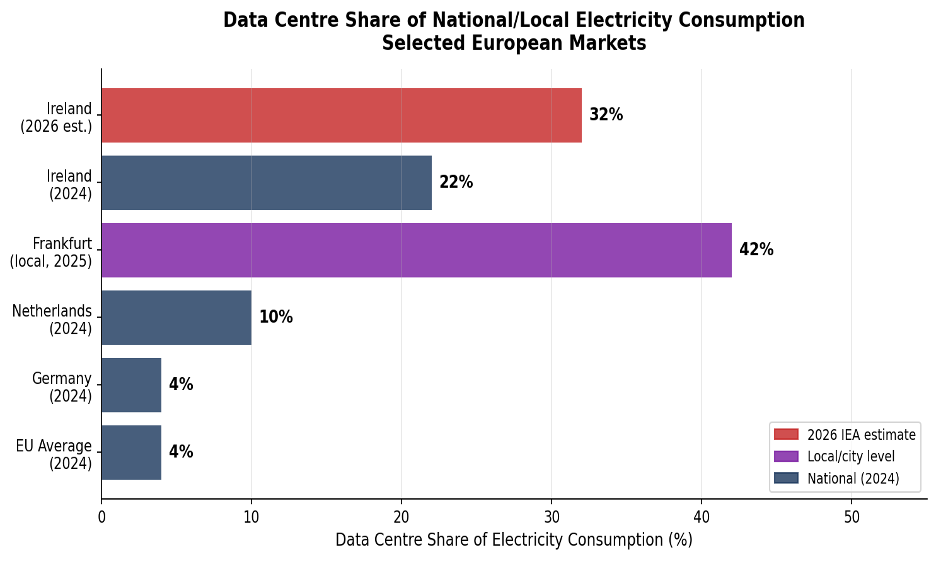
Chart 4: Data centre share of national or local electricity consumption, selected European markets. Sources: IEA, Brookings, Beyond Fossil Fuels, Eurelectric.
The geographic distribution of this buildout is shifting in an uncomfortable direction. Capacity constraints in Amsterdam and Dublin are pushing developers toward secondary hubs in Germany, Italy, and Spain. These are the same markets that are most exposed to gas-linked electricity pricing. Every additional gigawatt of baseload data centre demand in those markets means gas-fired plants are called upon more often. When those plants are dispatched, and when gas costs what it costs today, they set higher prices for everyone else on the grid. The two shocks are not merely coincidental; they are reinforcing each other through the same mechanism.
How bad could it get?
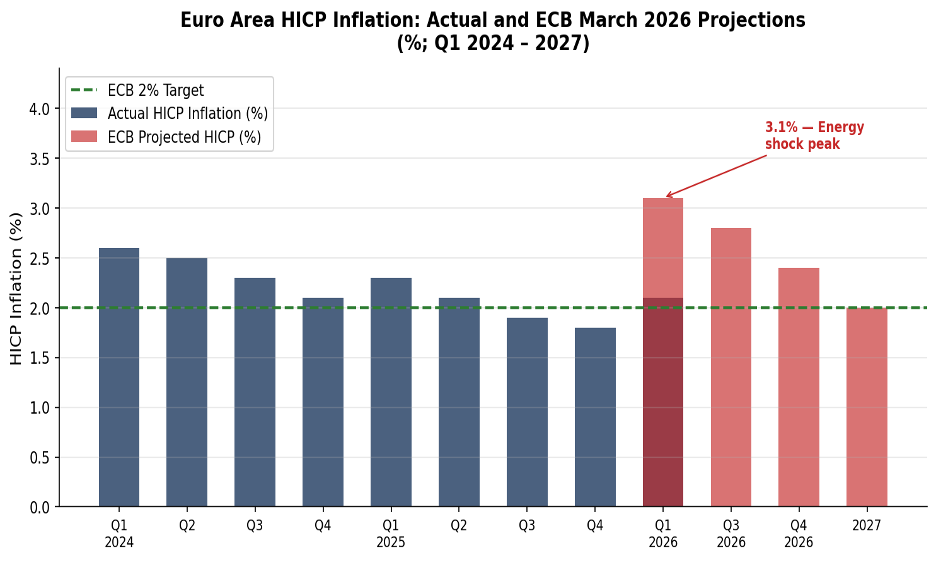
Chart 5: Euro area HICP inflation, actual and ECB March 2026 projections (%). Sources: Eurostat, ECB Staff Macroeconomic Projections March 2026.
The direct energy price impact is already showing up in the numbers. But the more worrying effect tends to arrive later. Food manufacturers and retailers typically set prices once a year; the elevated energy costs of mid-2026 will not appear fully in grocery bills until 2027 negotiating rounds. RaboResearch projects food inflation of at least 5 to 10% next year, potentially higher. Service sector wages, which adjust to compensate for inflation, are expected by the ECB to moderate more slowly than previously forecast. This is how a spike in wholesale gas prices becomes embedded in the general price level for years.
European governments could, in theory, absorb some of this through subsidies and price caps, as they did in 2022. This time they are less able to. Debt levels are higher. Defence spending is rising fast in response to the same geopolitical environment that is pushing energy prices up. Fiscal space is tighter. More of the shock will pass through to households and businesses than it did four years ago.
Even if the war ends tomorrow, the data centres will still be there, consuming electricity for the next twenty years.
The counterarguments deserve honest weight
There are serious reasons to think the worst case will not materialise, and they should not be dismissed. The most important is efficiency. The IEA notes that the power required per AI task is falling faster than almost any comparable technology in history. Better chip architectures, more efficient inference methods, and improved cooling designs are all reducing the energy intensity of the workload. This is genuinely significant.
The honest response, however, is that efficiency gains have not so far been enough to offset volume growth. Data centre consumption rose 17% last year despite those improvements. The IEA’s own projections, which incorporate continued efficiency gains, still show demand doubling by 2030. Jevons’ Paradox, the observation that cheaper, more efficient technology tends to be used more rather than less, appears to be operating in full force. Efficiency is slowing the growth of the problem; it has not reversed it.
A second counterargument points to renewables. Wind and solar generated more electricity across the EU than fossil fuels for the first time in 2025. France is bringing its nuclear fleet back to full capacity. These are real changes and they will, over time, reduce gas’s role as the price-setter in European electricity markets. The difficulty is timing. For gas to stop setting the marginal price, Europe would need enough storage and grid-scale batteries to cover demand during the hours when wind does not blow and the sun does not shine. That infrastructure does not exist at scale today, and it will not be built in the next 18 months. The structural relief is real but it is years away.
Market reform could help. The European Commission has discussed mechanisms that would allow electricity buyers to contract directly with renewable generators at fixed prices, bypassing the gas-linked spot market. Some of this is already happening. But reforming a continent-wide electricity market is a slow process, and the shock is happening now.
On balance, the counterarguments shift the timeline more than they change the direction. Efficiency and renewables mean this inflationary episode is unlikely to be as severe or as permanent as the most alarming forecasts suggest. They do not prevent it from being a meaningful and persistent problem over the next two to three years.
Where Nordic investors stand
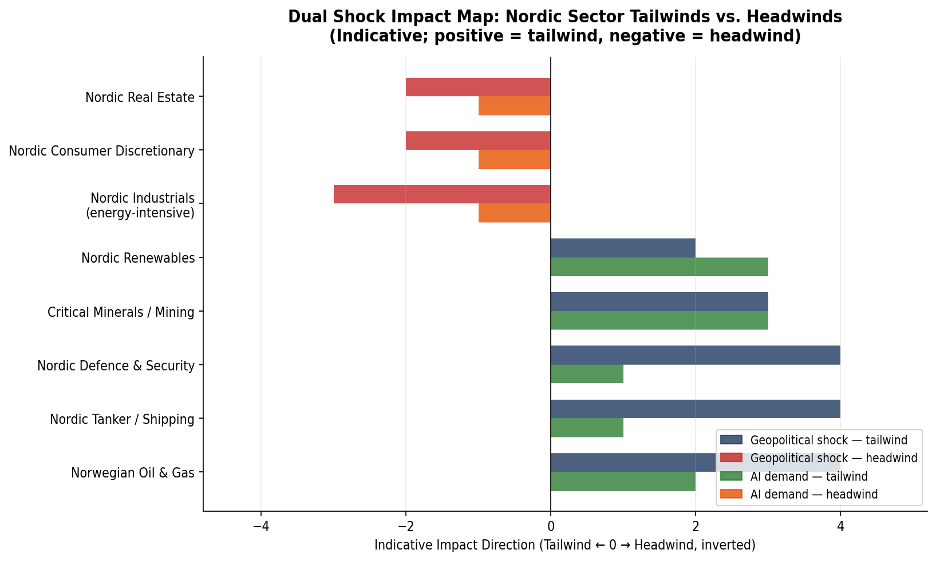
Chart 6: Dual shock impact map, Nordic sectors (indicative; positive = tailwind, negative = headwind). Nordic Funds and Mines analysis.
For investors based in the Nordic region, this environment is not uniformly threatening. It is deeply asymmetric, and the asymmetry tends to run in their favour. Norway sits on the other side of this shock from Germany. As Europe’s largest gas exporter, its producers are booking revenue at exactly the elevated TTF prices that are inflicting pain on European industry. Its hydro-dominated domestic grid means Norwegian businesses pay electricity costs well below their German counterparts, a competitive advantage that widens as TTF rises. Its sovereign wealth fund provides fiscal headroom that no EU member state can match. Norway is, structurally, one of the clearest beneficiaries of a prolonged European energy shock.
Beyond Norway’s upstream position, the shipping and tanker sector represents a second cluster of direct tailwinds. The Hormuz disruption has rerouted global LNG and oil flows onto longer paths, increasing voyage distances and elevating freight rates for the Scandinavian maritime businesses that were already identified in our March 2026 Nordic Funds and Mines research as primary beneficiaries of the Iran war. Those conditions have intensified since that analysis was written.
Nordic defence businesses form a third tailwind cluster. European governments are committing to rearmament spending that was debated in percentage-of-GDP terms just three years ago and is now being appropriated. Those budgets are multi-year and contracted in advance, insulating the revenues of Nordic defence manufacturers from the consumer spending compression that rising energy bills will cause elsewhere.
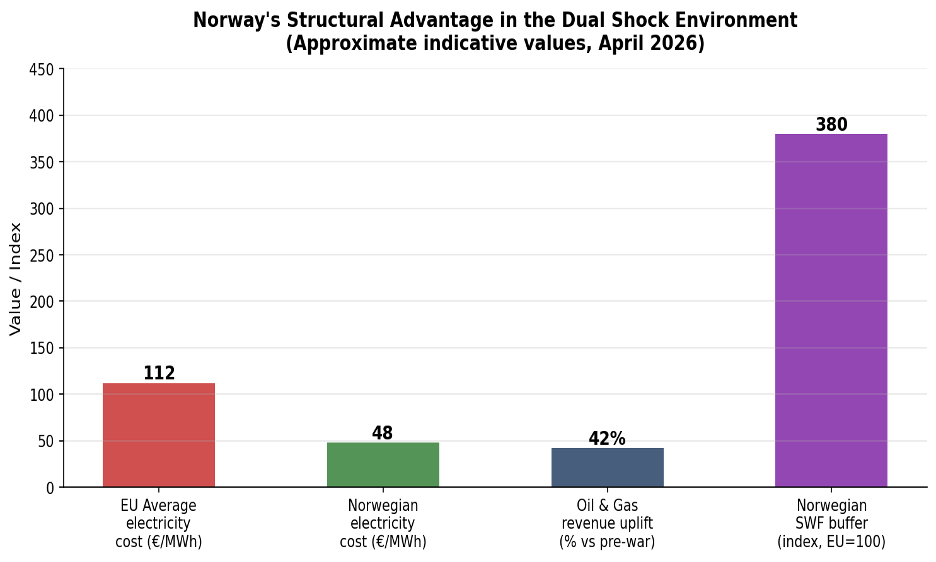
Chart 7: Norway’s structural position in the dual shock environment (indicative values, April 2026). Sources: IEEFA, ECB, Norwegian Ministry of Finance, Norges Bank.
Critical minerals occupy a different position, valuable but less immediate. The energy transition buildout and AI infrastructure construction both require copper, lithium, rare earths, and other materials in which the Fennoscandian region has significant reserves. The EU’s policy urgency around domestic supply chains for these materials is real and growing. The investment case is strong over a three-to-five year horizon; the near-term revenue realisation depends on permitting and capital allocation timelines that are slower than the price signals driving them.
The sectors to avoid are less complicated to identify. Energy-intensive manufacturers with EU customer exposure, consumer discretionary businesses selling into households whose energy bills are rising, and leveraged real estate facing an ECB that may raise rates precisely as growth slows: these are the quadrant where the dual shock produces headwinds from both directions at once. The ECB’s dilemma is worth noting. Raising rates to contain energy-driven inflation in Germany imposes real costs on economies like Spain and Sweden that are less exposed and may not need the same intervention. That tension will not resolve cleanly.
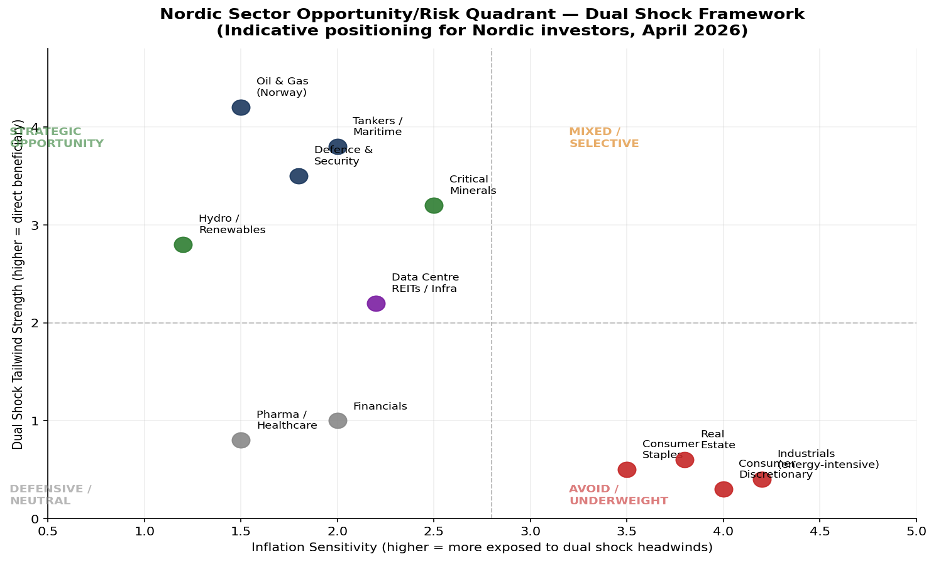
Chart 8: Nordic sector opportunity/risk quadrant, dual shock framework (indicative, April 2026). Nordic Funds and Mines analysis.
The most important timing observation for Nordic investors is this: the tailwind sectors have already begun repricing upward. The headwind sectors have not yet felt the full downstream effect. Food inflation is locked in the pipeline. Service sector wage pressure is building. Consumer demand compression, which will show up in the revenues of discretionary and industrial businesses exposed to European households, has not yet appeared in reported earnings. The gap between when the energy shock hits and when it fully transmits through the economy gives investors who understand the lag structure a window to act.
Disclaimer: This article is analytical research based on publicly available information as of April 2026. It does not constitute investment advice or a recommendation to buy or sell any security. Readers should conduct independent research and consult qualified financial advisors before making investment decisions.
Written by Moneer Barazi, Head Analyst at Nordic Funds and Mines